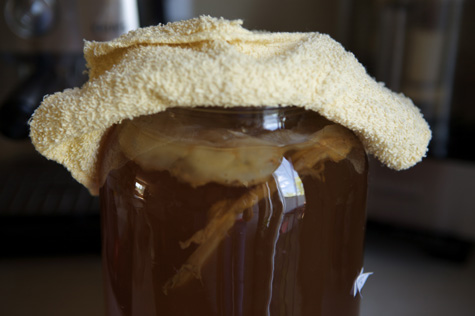
Kombucha, that magical mysterious elixir, is actually quite easy to produce with a bit of kitchen chemistry. I wrote about Kombucha a few weeks back, after I’d finished my first batch. And as promised in that article, here’s your step-by-step guide to home brewing.
What You’ll Need:
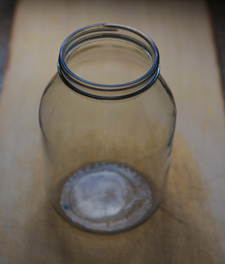
- A living SCOBY + some starter tea
- A large *glass* jar (no metal, no ceramic, no plastic, etc) with a wide opening (a standard 1-gallon jar, as shown at right, is best)
- Sugar
- Caffeinated tea
- A very clean cloth + a rubber band
- A steel pot and a big metal stir spoon
Prep Work
- Most likely, the hardest part will be getting your hands on a SCOBY. You’ll just have to be creative and snoop around your city for a source. I suggest starting with Craigslist or googling ‘[your city] kombucha’. You can also try poking around your local co-op or health food store – and check the bulletin board.
- Once you’ve secured a SCOBY (and it’s alive, floating in some starter tea), you’re on your way. Make sure your workspace is clean and at least semi-sterile. Gather and clean your tools (see above).
- This is a long process, so set your schedule accordingly. Brewing is a good Sunday project; you can have it going while you’re gardening or cleaning or laying around naked with your sweetheart.
How To Brew
1) In a large, stainless steel (non-teflon or other weird material) stock pot, boil 1 gallon of water. Keep it at a full boil for at least 10 minutes.
2) Remove the pot from heat and add 1 1/4 cups sugar, stirring with a metal (non-plastic, non-wood) spoon. I use organic evaporated cane juice instead of white sugar. DO NOT substitute agave, honey, Splenda™, or any other sweetener.
3) Add the tea. Any kind, as long as it’s caffeinated. This will determine the final flavor, so if you use a cranberry green tea, you’ll get a cranberry-ish flavored kombucha. I usually use organic plain green or black tea bags. You can use bagged or loose tea, but if you use looseleaf make sure it’s in a fine-meshed infuser. You don’t want any tea leaves floating about!
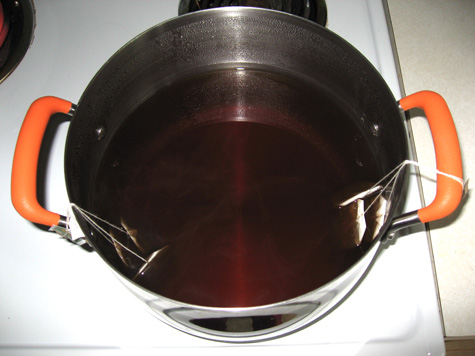
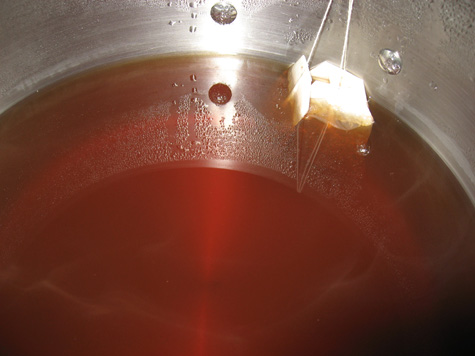
4) Steep the tea for about 4 hours, allowing the water to cool and the tea to get nice and strong. Go ahead and garden or clean or or lay around naked. When the tea is good and strong (many hours later), take out the tea bags/infuser.
5) Double check that your widemouth glass jar is very clean, and then pour in the gallon of sweetened tea. A funnel can really help with this.
DON’T USE ANY METAL BEYOND THIS POINT
Metal reacts poorly with the kombucha culture. It’s not a good thing.
6) Wash your hands thoroughly before handling the SCOBY.
7) Open your SCOBY + starter container, and pour the starter into the widemouth jar. There may be gooey strings or giblets – that’s just SCOBY stuff, and it’s fine.
8) Fish out your SCOBY. Admire it’s alien oddity. Blow it a kiss. Give it a name (mine is Scoby-Doo). Notice that there’s a ‘smooth side’ that is lighter, and the other side is darker. The slimy dark stuff is yeast. You’ll also notice that familiar, uniquely komucha-esque odor!
9) Now carefully slide your SCOBY into the widemouth jar, smooth-side up. It may sink, which is okay, but it will probably float.
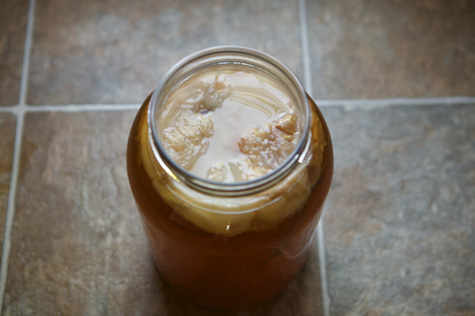
10) Place the clean cloth over the top of the jar, pulling it taught and securing with a rubber band. Now you just need to tuck that sucker away for 2-3 weeks. It prefers a warm dark spot, like in a cupboard or closet. It does not like drafts or sunlight, so don’t brew your kombucha on a window sill!
11) Adjust the brew time for your taste preference. The warmer it is, the faster it will brew. The more caffeinated it is, the faster it will brew. The longer you let it brew, the stronger and less sweet it will be. I like less sugar, so I ferment for at least 3 weeks. It’s not recommended that you brew a batch longer than a month.
— weeks later —
12) First, you’ll need to remove the SCOBY. Every time you brew, the ‘mother’ (the original SCOBY) grows a ‘baby’ (a new SCOBY). These names are misleading because the two are identical in every way, indistinguishable from one another. They’ll be stacked together, like two pancakes. You can either leave them be and keep on going with a double-thick SCOBY, or you can carefully separate them. If you do take them apart, each one can brew its own batch. Then you can stagger your batches for constant kombucha flow! Remember: each time you brew, the mother makes a baby.
13) You’ll need a jar to hold your SCOBY while you’re not brewing. Make sure the jar has a plastic (non-metal) lid. With very clean hands, fish your SCOBY out of the widemouth jar and fold it into the storage jar. Then add enough of the new brew to completely cover it. This is your starter tea for next time. Store the SCOBY + starter tea in the refrigerator, indefinitely.
14) Portion out your brewed kombucha into smaller storage containers. I save glass bottles with plastic lids just for this purpose. Store the tea in the fridge for up to 6 weeks.
15) Drink! Experiment! Enjoy!

Notes on Safety
- Wash your hands, wash your hands, wash your hands.
- Sometimes a culture will become contaminated. It happens! If your SCOBY shows anything resembling mold, TOSS IT! If your brewed kombucha comes out smelling funny, TOSS IT! If your kombucha ends up tasting funny, TOSS IT! Remember, there’s only a porous rag separating your fermenting sugar water from any and all airborne bugs. Contamination can happen, so be wise and play it ‘better safe than sorry’, okay?
- If you want to add fruit juice to your kombucha, do it after you’ve brewed. DO NOT add fruit juice before fermentation.
- Don’t use bleach on any of your kombucha-making equipment. Vinegar is a great cleanser. The dishwasher (with a mild detergent) is also okay.
- Listen to your body! Start by drinking a little at a time. Home brew is A LOT stronger than the store bought stuff, and the B-vitamins can get you quite heady. So take it slow and listen to your body!
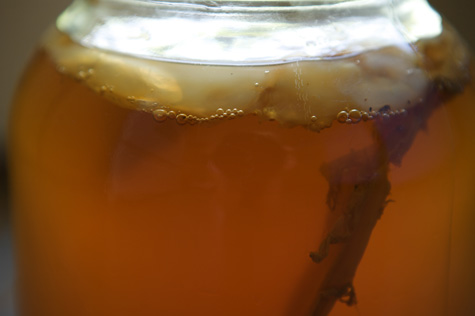
Close-up during the brewing process - you can see it bubbling away!
***DISCLAIMER – My dears, I cannot be held responsible for what you do with this information. So please, use your big beautiful brains, and be thoughtful and be careful.***
I know there’s been a ton of interest out there, so I can’t wait to hear how this works for you guys. Make sure to report back! And LUCK!




Pingback: Cheek ‘Booch! (aka Snail ‘Booch) | Caracol Wellness
Pingback: Kombucha: Not so scary after all.
Pingback: Kombucha love! | Polymind
Pingback: Brew Your Own Kombucha | Caracol Wellness
Pingback: Hibiscus Kombucha