I love cilantro. I know it’s too much for some people, but I grew up in southern California and Mexican is my favorite cuisine. I love cilantro in my salsas (especially good in a mango pico de gallo), I love cilantro in my tacos (it pops so well against soyrizo!), and I especially love cilantro in my favorite food of all, the burrito. It’s also great in Thai and Vietnamese, and of course in the ever-important green smoothie. I guess that’s why I grow so much of it!
But why am I talking about cilantro? I though this was a post about harvesting precious coriander . . .
Well my dears, they are in fact one and the same. Well, sort of. Both ‘cilantro’ and ‘coriander’ can be used to describe the plant as a whole. But in common culinary terms, cilantro is the leaf and coriander is the seed. These seeds have a delightfully warm, nutty, almost citrus-y flavor, and are an integral staple in Indian and Middle Eastern dishes.
So until recently, I was one of the many people who grew my own cilantro, but purchased my coriander. How silly! With a little patience (a relaxing Sunday afternoon with a really fun podcast) and a little planning, it’s easy to ‘have your cilantro, and eat your coriander too’.
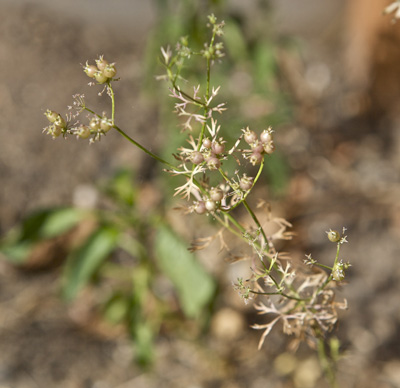
Coriander seeds form when the cilantro begins to dye back. Allow them to mature as the plant browns, and then harvest the plant before they’re released. Place the plants in a brown paper sack to dry out completely.
A week or two later, remove the stalks from the bag. The seeds reside in little round pods at the ends of the stems. Separate the seed pods and compost the leftover debris.
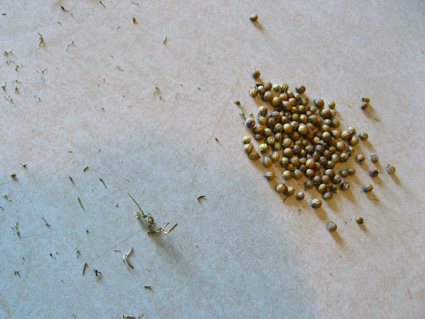
Now comes the finicky part. You need to remove the seeds from the pods, which should be relatively easy if the pods are pretty dry. You do this by rubbing the pod between your thumb and forefinger, or rubbing a bunch of them in a napkin or something. The outer sheath should separate, leaving two half-globe shaped seeds. If they’re not dry enough, you’ll have to pry the outer layer off with your fingernails, which can be *ahem* a p.i.t.a. Eventually, you’ll be left with a collection that looks something like this:
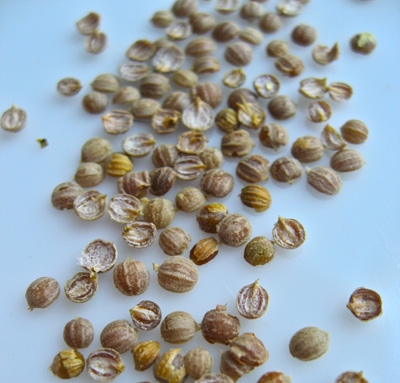
Success!
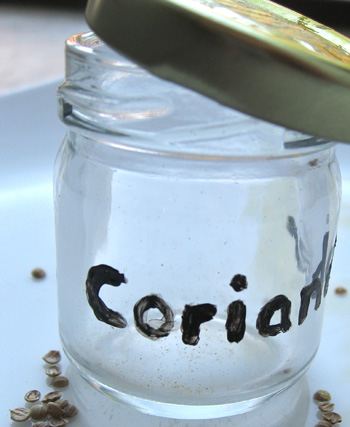
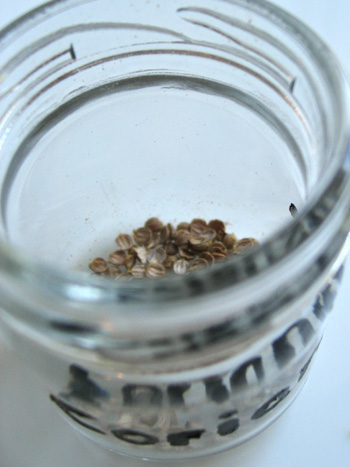
Store your spice in a tight-lidded jar in a cool dry place.



-
http://matkelly.com me3
-
Lynn
-
Vickie
-
MathTutor
-
Kiwi Kit
-
Majikthise